
Live, Laugh, Lamp | Moth Requests OPEN |Unreliable Posting Schedule (usually on Sundays)
60 posts
Moth Of The Week
Moth of the Week
Cinnabar Moth
Tyria jacobaeae
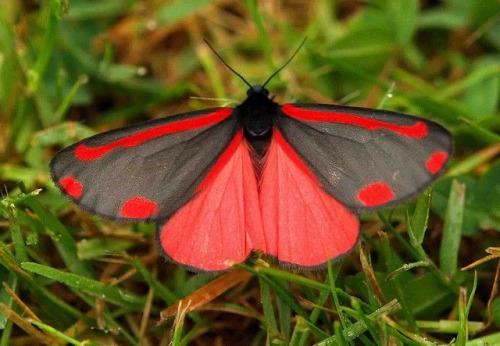
The cinnabar moth is part of the Erebidae family, one of the largest moth families. It is named after the mineral cinnabar, which is a similar bright red to the moth’s red & black wings. This species was first described in 1758 by Carl Linnaeus and can be seen flying during the day and night.
Description Cinnabar moths usually have black forewings with red patterns and red hindwings with a black border. However on rare occasions, the red is replaced with yellow, or the forewings are red with a black border or fully black. These colors tell potential predators that the cinnabar moth is unpalatable, or has a unpleasant bitter taste.
Average wingspan of 37 mm (≈1.5 in)
Diet and Habitat These moths are native to Europe, eastern and central Asia, Siberia, and China. This species feeds on plants in the Senecio genus, especially ragwort. This plant is the reason why cinnabar moths do not taste good to predators since the caterpillars absorb bitter substances from the ragwort’s leaves. This plant is also why the cinnabar moth was brought to New Zealand, Australia, and North America since ragwort is an invasive plant species.
Mating Mating season for cinnabar moths is in early August. Female moths can lay up to 300 eggs on the underside of ragwort leaves in batches of 30 to 60 eggs.
Predators Most predators avoid cinnabar moths and larvae, except for various species of the cuckoo bird. Cinnabar moths have few predators because are a bright red, signaling to predators that they are unpalatable, or have a unpleasant bitter taste.
Fun Fact (CW: cannibalism) If and when the cinnabar caterpillars run out of leaves to eat on the ragwort plant, they will turn to cannibalism and eat each other for survival.
(Source: Wikipedia, Buglife)
-
 rhino-beetles reblogged this · 1 year ago
 -
 bkuwabara reblogged this · 1 year ago
 -
 betweenthefeelingandthesound liked this · 1 year ago
 -
 peabeabluejay liked this · 1 year ago
 -
 selki liked this · 1 year ago
 -
bkuwabara liked this · 1 year ago
-
 cynicalwindmill reblogged this · 1 year ago
 -
 roly-poly-amori reblogged this · 1 year ago
 -
 beelzebby666 reblogged this · 1 year ago
 -
beelzebby666 liked this · 1 year ago
-
 cantankerouscatfish reblogged this · 1 year ago
 -
 stunt-muppet liked this · 1 year ago
 -
 microecobus liked this · 1 year ago
 -
 blujayonthewing liked this · 1 year ago
 -
 zigcarnivorous liked this · 1 year ago
 -
 the-arachnocommunist reblogged this · 1 year ago
 -
the-arachnocommunist liked this · 1 year ago
-
 drhoz reblogged this · 1 year ago
 -
drhoz liked this · 1 year ago
-
 iwannaseesex liked this · 1 year ago
 -
 coolthinghere liked this · 1 year ago
 -
 bepoooooo liked this · 2 years ago
 -
 tsundoku78 reblogged this · 2 years ago
 -
tsundoku78 liked this · 2 years ago
-
 dipstar1489 liked this · 2 years ago
 -
 cryptidlesbiangorl liked this · 2 years ago
 -
 i-am-nica reblogged this · 2 years ago
 -
 schmabbald reblogged this · 2 years ago
 -
 fruutypebbles reblogged this · 2 years ago
 -
 fruutbaag liked this · 2 years ago
 -
 babiicutthroatt liked this · 2 years ago
 -
 isfjmel-phleg liked this · 2 years ago
 -
 cakeyouareoh liked this · 2 years ago
 -
 zelzahdarkcloak reblogged this · 2 years ago
 -
 awk-1 liked this · 2 years ago
 -
 wordsfromthewick liked this · 2 years ago
 -
 breadparry liked this · 2 years ago
 -
 bardicmoths reblogged this · 2 years ago
 -
 pixel1678 liked this · 2 years ago
 -
 thesoulfirerevolution liked this · 2 years ago
 -
 mintaikk-deadaccount liked this · 2 years ago
 -
 crowyobroyo reblogged this · 2 years ago
 -
crowyobroyo liked this · 2 years ago
More Posts from Libraryofmoths
Moth of the Week
Nine-Spotted Moth
Amata phegea, formerly Syntomis phegea

The nine-spotted moth or the yellow belted burnet is a moth in the family Erebidae, the family of tiger moths. The species was first described in 1758 by Carl Linnaeus. The moths gets its names from the common nine spots on its wings and the yellow band on the sixth segment of its abdomen.
Description Both the moth’s body and wings are an iridescent blue on black or green on black. The wings usually have eight to nine white spots, six spots on the forewings and two or three spots on the hindwings. However the number and the size of these spots can vary per moth. Finally, the moth’s body has its own yellow spot in the second segment of the abdomen accompanied by a yellow band on the sixth segment. The antennae are thin black wires with white tips, unlike most moths’ antennae which are fluffy or saw edged.
Average wingspan of 37.5 mm (≈1.5 in)
Males are smaller than females and have thicker antennae.
Diet and Habitat The nine-spotted moth caterpillars eat many herbaceous plants such as bedstraws, dandelions, docks, fleaworts, grasses, and other low plants. This species is mainly found in southern Europe but makes appearances in northern Germany, Anatolia, the Caucasus, and the Dutch nature reserves of Leudal and Meinweg. It does not breed in the United Kingdom, but does immigrate there on rare occasions. They prefer drier areas such as open ranges with shrubs and trees, open forests, and sunny slopes.
Mating Adult moths mate in late May to August depending on location. Sources vary as to whether this species has one or three generations a year. Females lay an average of 104 eggs on host plants in groups of up to 61 eggs.
Predators The nine-spotted moth avoids predation by birds due to its mimicry of the Zygaena ephialtes. The Z. ephialtes is a moth unpalatable to birds, so its wings are brightly spotted to warn predators of toxicity. This is called aposematism.
Fun Fact The official term for the nine-spotted moth’s type of antennae is filiform, meaning thread-like. It is the most basic type of insect antennae.
(Source: Wikipedia, Moth Identification, CAB Direct, Amateur Entomologists’ Society)
Moth of the Week
Io Moth
Automeris io

The Io moth or peacock moth is in the family Saturniidae. The name Io comes from Greek mythology in which the mortal Io was turned into a cow by Hera for sleeping with Zeus. The eyespots are said to look like the eyes of a cow. The species was first described in 1776 by Johan Christian Fabricius.
Description Males have yellow to orangish yellow body, legs, and forewings with symmetrical brown patterned markings. On the hindwings are large black eyespots with a white center and surrounded by yellow, black, and red orange edges. Also on the hidwings are a large red orange edge on the edge closet to the body. Females have reddish-brown body, legs, and forewings with patterns in varying shades of brown. the hindwings are similar to those of the male but with maroon instead of red orange and a small light brown edge. Some hybridizations have resulted in variations in these hindwing eyespots.
Average wingspan: 75.5 mm (≈3 in)
Males have larger antennae
Females have larger bodies and wings
Diet and Habitat The io moth caterpillars first feed on the eggs they hatch from then their host plants. These host plants are a variety of grasses, herbaceous plants, shrubs, deciduous trees, and conifers. Some of these plants included the mulberry, pin cherry, willow, balsam fir, red maple, bastard indigo, wild indigo, American hornbeam, sugarberry or southern hackberry, button-bush, eastern redbud, showy partridge pea, sweetfern, flowering dogwood, and common hazel. Adults do not feed. This species’s preferred habitats are deciduous forests, thorn scrub, and suburban areas in continental North American. They range from Manitoba to Nova Scotia in Canada and from Montana to Texas and onward over all the eastern states in the United States.
Mating Io moths breed from late May to July, though southern populations may breed earlier and later in the season due to having several broods per seasons as opposed to the north’s single brood. The females emit pheromones to call males as soon as the second night after leaving the cocoon. Males detect female pheromones with their antennae and mating lasts for about 90 minutes staring around 9:45 to 10:30 pm. 3 to 5 days after mating, females lay their eggs in clusters of 20 to 35 on the host plants leave or stems. Eggs hatch after 8 to 11 days.
Average eggs laid: 300
Predators This species is harmed by many species of parasitic flies and wasps and hunted by birds, small mammals, and spiders. In defense, the caterpillars of the io moth have venomous spikes. This venom isn’t fatal to humans, but it does caus acute dermatitis. The adult io moths use their hindwing eyespots to scare off predators by shaking them to imitate a larger animal.
Fun Fact Adult moths are strictly nocturnal and rest on the branches or trucks of trees during the day.
(Source: Wikipedia, University of Florida, Missouri Department of Conservation, Butterflies and Moths of North America, Animal Diversity Web, Adopt and Shop, Kiddle)
Moth of the Week
Bogbean Buckmoth
Hemileuca maia menyanthevora

The bogbean buckmoth/bog buckmoth is part of the family Saturniidae. This moth was originally described under the Hemileuca maia complex or a group of closely related species in the genus of buck moths: Hemileuca. However, by using genomewide single nucleotide polymorphisms (SNPs), entomologists such as Julian R. Dupuis have found both Ontario and Oswego County, NY, populations of buck moths were not part of the H. maia lineage. In 2020, Pavulaan stated the bogbean buck moth may be its own species and called it Hemileuca maia menyanthevora.
Cryan & Dirig described the same taxon as species Hemileuca iroquois on April 2, 2020. The names have not yet been formally synonymized nor has one been discredited.
Description The females’ bodies are all black while the males’ are black with a red tip. Both have black/gray translucent wings. In the middle of the wings are a white band that flows from the forewings to the hindwings. Near the top edges of both wings in the white band is a gray and white eyespot. The forewing eyespot is larger than the hindwing spot.
Average forewing length: 29 mm (≈1.14 in)
Males have thicker antennae and females are slightly larger.
Adults are larger than other Hemileuca maia and the white wing bands are much larger than other H. maia
Diet and Habitat Larvae feed mainly on the plant bog buckbean, which is where they get their name. Adult moths do not feed. These moths are only found in calcareous fens where its primary host plant grows.
These moths have a limited range and are only found in ten colonies throughout the world: six located in Oswego County, NY, and four in eastern Ontario, Canada. In New York, bog buck moths can be found in wetlands sheltered by the eastern Lake Ontario dune network.
Mating Mating season begins around fall when the adult moths emerge. Female buck moths lay one large cluster of eggs on sturdy stems of a variety of plant species. The eggs overwinter and hatch the following spring. The eggs are never laid on the bog buckbean plants because they die back each year making them unable to support the eggs over winter.
Predators The eggs of the bogbean buckmoth are parasitized by the wasp Anastatus furnissi. Eggs are also preyed on by small mammals and invertebrates and may accidentally be ingested by white-tailed deer that eat the plant stems where eggs are laid. Egg predation is also observed from mites. All Hemileuca larvae have spines that can injure some vertebrate predators but do little to no to protect against parasitic flies and wasps.
Fun Fact Due to the rarity of this species, bog buck moths are considered an endangered species in New York.
(Source: Wikipedia; SLELO PRISM; New York Natural Heritage Program; Ontario.ca; U.S. Fish and Wildlife Service, Cortland, NY; Federal Register)

@turkeygamemaster
Moth of the Week
Polyphemus Moth
Antheraea polyphemus

This moth is another member of the Saturniidae family, or the great silk moth family. The Polyphemus moth gets its name from the eyespots on its wings and the Greek myth of the cyclops Polyphemus. This species was first described by Pieter Cramer in 1776.
Description Polyphemus moths come in many varying shades of brown and gray with pink, white, and black accents. These accents are called the “ante-medial” and “post-medial” lines on the forewings while the hindwings have only the “post-medial” lines. Along the lower edges of both the forewings and the hindwings, called the “outer margin,” is a large band which may vary in color based on the moth but is usually a lighter shade than the rest of the wing. Despite differences in color, all Polyphemus moths have four yellow and black eyespots, 2 on the forewings and 2 on the hindwings. The hindwings’ eyespots are more prominent than the ones on the forewings, being larger and having a thicker outline. The centers of the spots are transparent.
Average Wingspan: 15 cm (6 in)
Females have larger bodies for egg laying
Males have large antennae to detect female pheromones (type: quadripectinate, comb-like)
Diet and Habitat The larvae eat the leaves of beech trees, birch trees, oak trees, maple trees, willow trees, and a large range of other trees. Adult moths have smaller mouths and do not eat.
These moths have a very large habitat range, being found in all of continental North America, except for northern Canada, Nevada, and Arizona. The eggs are laid in deciduous hardwood forests, wetlands and orchards.
Mating When the female moths release their mating pheromones, males can fly miles to find them. Mating usually occurs at night in early summer and lasts 24 hours. Once finished, a female will lay 100 to 300 eggs, which the caterpillars will hatch from in 10 days.
Predators Polyphemus moth caterpillars, larvae, and pupae are prey to yellowjackets, ants, raccoons and squirrels. Adult moths use the owl like eyespots on their wings to scare off predators.
Fun Fact The Polyphemus moth caterpillar can eat 86,000 times its weight when it leaves its egg in a little less than two months.
(Source: Wikipedia, Animal Diversity Web, Animal Spot, and University of Florida, Entomology and Nematology Department)
Moth of the Week
Buff-Tip
Phalera bucephala
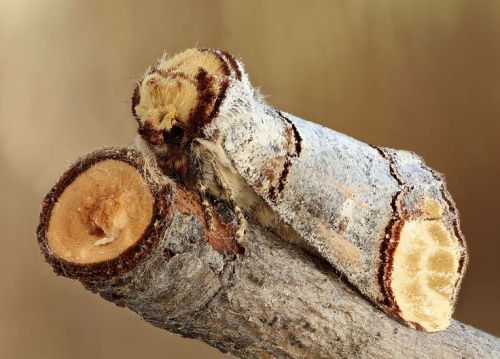
The buff-tip is part of the family Notodontidae and was first described in 1758 by Carl Linnaeus. They are best know for their resemblance of a broken birch twig when at rest. The name buff-tip comes from the color on the head and edge of the wings, buff: “a light brownish yellow, ochreous colour, typical of buff leather.”
Description The body is hairy, with a buff colored patch on the head followed by a brown ring. The upper body visible from under the wings is a mottled gray to match the forewings. The rest of the body is covered when resting and is a cream white with gray, cream and or brown legs. The forewings are also mottled gray with brown patterning and a buff patch at the tip mirrored on both sides. The hindwings are the same cream as the lower body. The antennae are brown and hidden when camouflaged.
Average wingspan: 55-68 mm
Males are smaller than females
Diet and Habitat Common food plants for this moth include the Norway maple, birch, chestnut, hazel, oak and many more. Caterpillars are social as young larva and eat in groups which can cause the defoliation of their host plants. Adult moths do not feed.
This moth is found across Europe and in Asia to eastern Siberia. It is very common in the British Isles, more so in the south than in the north. They prefer habitats with deciduous trees like open woodlands, scrubs, hedgerows, and urban gardens.
Mating Generally, the buff-tip can be seen from May to July, which is most likely their mating season. This moth is strictly nocturnal so it is also most likely they mate during the night. They have one generation per year with the females laying the eggs in clusters on the underside of leaves. The young larva are sociable and grow to be solitary through 4 instars.
Predators In order to protect itself while resting during the day, this species has adapted to look like a broken birch twig. This deceives common day time predators of moths such as birds and lizards.
Fun Fact This moth has been considered a pest in Lithuania for eating apple trees in the 1900s. High levels of environmental nitrogen compounds can increase outbreaks of the buff-tip.
(Source: Wikipedia, Wildlife Insight, London Wildlife Trust, Butterfly Conservation)