
Slob with a blog. Vicariously join me on my movie viewing adventures! Visit my blog here: http://jinglebonesmovietime.blogspot.com
297 posts
A STUDY IN TERROR (Dir: James Hill, 1965).

A STUDY IN TERROR (Dir: James Hill, 1965).
Fact and fiction collide as Sir Arthur Conan Doyle’s literary detective Sherlock Holmes pits his wits against infamous serial killer Jack the Ripper.
A mysterious medical kit with a distinct crest sets Holmes on the case of the notorious killer and of the prominent aristocratic family he suspects are involved. Taking in the back alleys of 1888 Victorian London and mixing with the lowlifes there in.
A Study in Terror presents us with a highly sanitised version of 1880s Whitechapel; the Ripper’s victims all beautiful with their 1960s coiffures. The movie does, on the surface, appear to be a bit of a romp and was misleadingly advertised as a Batman-esq spoof by US distributor Columbia Pictures. In actual fact the movie is, at times, a pretty grizzly affair.
Screenwriters Derek Ford and Donald Ford have crafted a tense, twisty thriller with moments of horror and plenty of jumps. Director James Hill’s innovative use of point-of-view shots give the murders an extra viscerality while keeping the identity of the killer a mystery. The movie does have a somewhat misogynistic tone, which is perhaps inevitable considering its subject.
John Neville has just the right austerity as Holmes while Donald Houston is an amiably bluff Watson. A fantastic supporting cast includes Brit acting legends Anthony Quayle, Robert Morley and Judi Dench. Best of all is Barbara Windsor as Ripper victim Annie Chapman. Slightly stepping outside of her Carry On... persona, she gives us an all too rare glimpse of her acting ability beyond the giggly, busty blonde stereotype.
With its misogyny and grim use of fictionalised real life murders, you can safely wave goodbye to good taste. Yet, in spite of my misgivings over content, I thoroughly enjoyed A Study in Terror. What, on the surface, threatens to be an exploitative, sensationalist shocker is actually a well produced thriller with a fine cast. Recommended especially to Holmes aficionados and fans of 1960s British cinema.
Visit my blog jinglebonesmovietime.blogspot.com for more classic movie reviews!
-
 thewaytonowhere liked this · 3 years ago
 -
 victorianwhitechapel liked this · 4 years ago
More Posts from Jingle-bones

STUDENT EXCHANGE (Dir: Mollie Miller, 1987).
A lightweight teen comedy from Walt Disney Television. Originally screened in two parts on ABC's The Disney Sunday Movie series.
Greeley High School students Carole and Neil are top of the class academically but bottom of the heap socially. Passing themselves of as foreign exchange students in a bid to be noticed, they are a hit with fellow pupils, less so with the school principal. Predictably, things get a little out of hand and the pair are soon wishing they were their old selves again.
Inexplicably, identity switch movies were something of a Disney Sunday Movie staple in the 1980s. The previous season had presented Young Again (Steven Hilliard Stern, 1986), Double Switch (David Greenwalt, 1987) and Double Agent (Michael Vejar, 1987) while the current series also offered Rock 'n' Roll Mom (Michael Schultz, 1988) and 14 Going on 30 (Paul Schneider, 1988). Meanwhile The Disney Channel was churning out a seemingly endless series of sequels to Disney's original switheroo comedy The Parent Trap (David Swift, 1961).
There is little in Student Exchange that is particularly original and nothing that really makes it stand out among the plethora of teenage wish fulfillment movies. Mollie Miller's direction is solid and the performances are fine, although the production cannot quite shake the feeling of an extended TV episode.
It also suffers from a message that is slightly muddled. While it is undoubtedly important to be yourself, Student Exchange makes it seem a lot more fun to be the popular kid and get the girl/boy of your dreams.
Viveka Davis and Todd Field are likeable leads, but perhaps of more interest to modern audiences is the supporting cast. A post-Bionic Woman Lindsay Wagner, pre-fame Heather Graham and pre-infamy O J Simpson all put in appearances.
Student Exchange is a pleasant enough nostalgia trip. Teens and tweens of the late 80s may get more out of it than anybody else. But i don't see why younger audiences wouldn't enjoy it too; essentially it is a modern day Disney Channel movie in 1980s clothing. It is predictable and formulaic but also good-natured fun.
Visit my blog JINGLE BONES MOVIE TIME for a longer, more in-depth review of Student Exchange!

THE DARK CRYSTAL (Dir: Jim Henson & Frank Oz, 1982).
Coming to Netflix on 30th August 2019 is The Dark Crystal: Age of Resistance the prequel to Muppets creator Jim Henson’s original fantasy epic The Dark Crystal. My inner 8 year old can barely contain his wee wee at the thought of this so, in anticipation, I revisited the original.
Believing he is the last of his elf-like Gelfling race, Jen sets out to fulfill a prophecy which foretells that a Gelfling will one day defeat the malevolent Skeksis who rule his homeland of Thra. Jen must locate and replace a missing shard from the mystical crystal from which the Skeksis draw their powers. Learning of the quest, the Skeksis will stop at nothing to deter Jen, having already murdered his kind for their own evil gains.
Co-directed by fellow Muppeteer Frank Oz, The Dark Crystal was seen as a major departure for Jim Henson. Along with conceptual artist Brian Froud, they created a beautiful, intricately detailed alien world populated solely by their elaborate puppet creations. The puppets, or Muppets, are exquisite creations, grotesquely beautiful and believably brought to life by the talented Muppet performers.
The overall tone of the movie is decidedly darker than that of The Muppet Show. However, I think its reputation as nightmare fuel is unwarranted. There is a lot of light to offset the dark and ultimately this is a positive tale with a uplifting message. There is also much humor; granted, it's not the knockabout humour of the Muppets, but the movie does have a lightness of touch that helps make the more sombre moments much more palatable for the young. I first saw The Dark Crystal at age 8 and survived. I would have no qualms about showing it to children of a similar age.
For those who have never seen this magical movie I wholeheartedly recommend it. The eagerly anticipated prequel will, apparently, not require you to be familiar with the original, but I would suggest you give it a watch anyway, simply because it is a fantastic piece of fantasy filmmaking.
Visit my blog JINGLE BONES MOVIE TIME to read a longer, more in-depth version of this review! Link below.

THE RICHEST CAT IN THE WORLD (Dir: Greg Beeman, 1986).
By 1986 Walt Disney branded feature films had all but died out, the studio finding greater success with movies released through its adult oriented Touchstone Pictures division. Conversely the opposite was true on television where the success of the fledgling Disney Channel (launched in 1983) and the re-invigorated Disney anthology TV series had created a demand for new made-for-television feature content. One such feature was The Richest Cat in the World.
Palmer the cat stars as Leo, a pampered puss left $5 million in the will of his deceased owner Oscar (Ramon Bieri). When Oscar’s nephew learns of this he and his wife set out to kidnap and dispose of Leo, thereby inheriting the cash themselves. Leo confides his ability to speak (!) to an employee’s children who determine to protect the cat and stop the catnappers from stealing his fortune.
The Richest Cat in the World debuted on the newly re-titled The Disney Sunday Movie on the ABC network. In truth, TV is where this modest comedy-thriller belongs. Greg Beeman directs with a smooth efficiency but cannot disguise the movie's TV origins. The teleplay by Marshall Efron and Alfa-Betty Olsen is satisfactory enough, but with marked similarities to Disney's animated The Aristocats (Wolfgang Reitherman, 1970) is not particularly original. To describe the slapstick humour of the movie as broad would be an understatement. To be fair, there are some laughs to be had, not just ironically; there is something inherently funny about a cat using a touchpad telephone to order a pizza!
The Richest Cat in the World is just silly enough to appeal to young audiences and nostalgic enough to appeal to adults who enjoyed it when they were young. It is wholly innocent and appealing in a ramshackle kind of way, especially if you like cute cats. It is the kind of movie where you can predict the ending in the first five minutes but, if you are in the right mood, it should raise the odd chuckle and honestly, I can think of worse ways to waste 90 minutes.
Visit my blog JINGLE BONES MOVIE TIME to read a longer, more in-depth review of The Richest Cat in the World! Link below.
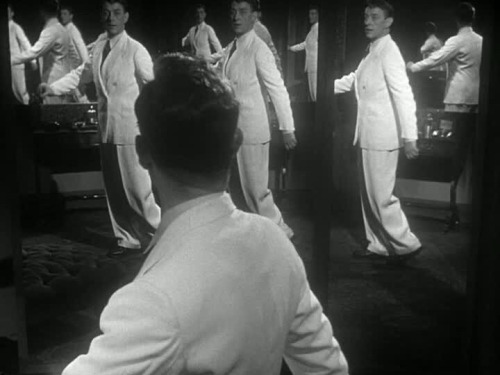
THE MAN IN THE WHITE SUIT (Dir: Alexander Mackendrick, 1951).
Ealing Studios were on fine form in 1951, producing two classic comedies. The Lavender Hill Mob (Charles Crichton) released in June, was followed two months later by possibly the greatest Ealing comedy of all, The Man in the White Suit.
Set in the textile mills of the north of England, The Man in the White Suit tells of Sidney Stratton (Alec Guinness), a research chemist who delivers a new wonder fabric. Indestructible and dirt repellent, the miracle fabric initially has Sidney lauded a genius. However, once the ramifications of such a product become clear, both mill owners and trade unions are keen to suppress Sidney and his invention.
In some repects, The Man in the White Suit in atypical of the Ealing Comedies. It shares with the others the broad theme of the individual vs the Establishment, but here seems to be taking a swipe at trade unions and the common man. In actuality its view of big business and commercialism is just as critical. Yet here, the 'little guy against the system' is a more ambiguous figure than usual. Although Sidney's noble ambition to clothe the world in indestructible fabric is a commendable one, ultimately the price of doing so would come at too great a cost. As his landlady remarks "What's to become of my bit of washing when there's no washing to do?" On the flipside of this is the wealthy mill owners whose greed sees them clamouring for Sidney's invention before attempting to suppress it, initially with bribes, then with more underhanded means. Business and labour eventually side with each other as poor Sidney is chased through the dark streets with his suit glowing luminous white! While the audience sympathy undoubtedly lies with Sidney, we are not too sorry at his inevitable downfall.
Thankfully, social commentary does not get in the way of this being a very funny film. The astute screenplay by John Dighton, Roger MacDougall and Alexander Mackendrick nicely balances the two opposing sides of industry with equal satirical bite. Mackendrick directs at brisk pace, creating a real feeling of suspense in the final moments.
Alec Guinness, arguably the greatest comic actor all time, is excellent here. His childlike optimism offsetting the cynical nature of the film. While Sidney’s blinkered belief in his invention is foolhardy, Guinness never portrays him as foolish, eliciting audience sympathy for a character who could have easily evoked derision. Reunited with Guinness is his Kind Hearts and Coronets (Robert Hamer, 1949) leading Joan Greenwood, equally effective here as his chaste love interest.
The Man in the White Suit walks a thin line between cynical satire and offbeat whimsy, but it does so with ease. I would argue it is the greatest of the Ealing comedies and an absolute comedy masterpiece. Highly recommended to anybody with the slightest semblance of a sense of humour.
Check out my blog JINGLE BONES MOVIE TIME for more reviews of classic Ealing Studios movies!

A BILLION FOR BORIS (Dir: Alex Grasshoff, 1984).
A Billion for Boris is the film adaptation of Mary Rodgers' sequel to her novel Freaky Friday.
Repairing an old TV set, Ben ‘Apeface’ Andrews (Seth Green) fixes it to show the next day’s programmes. He duly shares this information with his sister Annabel (Mary Tanner) and friend Boris (Scott Tiler). Seeing the money making potential, Boris heads off to bookies, but his winning streak attracts the unwanted attention of gangsters.
A movie version of Freaky Friday (Gary Nelson) was released by Walt Disney Productions in 1976. Although popular, Disney chose not to film either of Rodgers’ published sequels. A Billion for Boris was brought to the screen almost a decade later courtesy of independent Comworld Pictures.
As such, it is an adaptation of the sequel to the novel, rather than a sequel to the Disney feature. The setting, as in Rodgers’ books, is a New York apartment block, not the suburban Los Angeles of Disney’s Freaky Friday. The events of the earlier movie are not referenced, with the exception of the firing of the Andrews’ housekeeper for stealing liquor.
As a low budget production, A Billion for Boris lacks the polish of Freaky Friday. Also missing is Rodgers’ prose; as screenwriter of the original movie she captured much of the spirit of her book, even though significant changes were made to the plot.
Its largely unrecognisable cast doesn’t have the appeal of the previous movie. Of the adults, Lee Grant does a neat turn as Boris’ quirky mom. Future star Seth Green is standout among the kids as ‘Ape Face’.
In spite of this, it is still an entertaining movie. Some might question the theme of underage gambling and while it would raise a few eyebrows today, I doubt it did in 1984. Use it as opportunity to discuss with your kids the morality of betting if you will, but I wouldn’t let it put you off.
While A Billion for Boris doesn’t raise big laughs it does provides some chuckles. I am fairly certain I won’t revisit it as often as Freaky Friday, a childhood favourite that holds up as an adult. However, it does hold curiosity value to fans of that movie and is undemanding, lightweight fun.
Check out my blog JINGLE BONES MOVIE TIME for more movie reviews!